
Introduction: A Common Problem That’s Often Misunderstood
Have you ever wondered — Why does your skin feel stretched and dry again just a few hours after applying even the most expensive creams?
This is an extremely common problem in Bhuj, Kutch and across Gujarat. Every day, patients come to me (Dr. Jigar Gor, Ayurveda Expert) saying:
“Doctor, I’ve tried every cream available, even imported products, but nothing works. My skin remains just as dry as before.”
If you feel the same way, this blog is for you.
According to Ayurveda, the problem of Ruksha Twak (dry skin) is not merely an “external deficiency.” It is a cry from deep within the body — a sign of internal imbalance that cannot be solved no matter how many creams you apply, unless you understand the root cause.
Let’s understand this problem deeply through the lens of Ayurveda.
Understanding the Skin: What Does Ayurveda Say?
Twak (Skin) — The Mirror of the Body
In Ayurveda, skin is not considered merely an external covering. Acharya Sushruta wrote:
“Twak Mamsadhatusya Upadhatuhu”
— Sushruta Samhita
Meaning: Twak (skin) is the Upadhatu (secondary tissue) of Mamsa Dhatu (muscle tissue).
In simple terms — when you eat food, it first transforms into Rasa Dhatu (nutrient fluid/plasma), then Rakta (blood), then Mamsa Dhatu (muscle tissue). The nourishment of this Mamsa Dhatu is what gives the skin its glow, softness, and moisture.
The Seven Layers of Skin
According to Ayurveda, the skin has seven layers (Twak Sapta Patal):
| Layer | Sanskrit Name | Function |
|---|---|---|
| 1 | Avabhasini | Complexion and radiance |
| 2 | Lohita | Influence of blood |
| 3 | Shweta | Pigmentation |
| 4 | Tamra | Protection from infection |
| 5 | Vedini | Sensation |
| 6 | Rohini | Wound healing |
| 7 | Mamsadhara | Stability and support |
When we apply oil or cream externally, it mainly reaches only the first and second layers. The inner layers must receive nourishment from within.
The Real Causes of Dry Skin: Ayurvedic Analysis
Samprapti (Pathogenesis) — How the Disease Develops
In Ayurveda, to understand any disease, we examine its Samprapti (the process of disease formation). At my clinic MS Ayurved in Bhuj, when I (Dr. Jigar Gor) examine patients, this sequence becomes clearly visible:
       Ruksha Ahara-Vihara (Dry food & lifestyle)
                ↓
       Vata Dosha Vriddhi (Aggravation of Vata)
                ↓
       Agnimandya (Weak digestive fire)
                ↓
       Rasa Dhatu Kshaya (Depletion of nutrient fluid)
                ↓
       Mamsa Dhatu Aposhan (Malnourishment of muscle tissue)
                ↓
       Twak mein Snigdhata Kshaya (Loss of oiliness in skin)
                ↓
       Bahya Snehana Vifal (External oiling becomes ineffective)
Bhrajak Pitta — The Skin’s Own Agni (Fire)
According to Ayurveda, a special type of Pitta resides in the skin — Bhrajak Pitta.
Main Functions of Bhrajak Pitta:
✅ Providing Prabha (natural glow) to the skin
✅ Absorbing externally applied oils and creams
✅ Regulating skin temperature
✅ Maintaining the skin’s immune function
When Bhrajak Pitta becomes weak:
- Applied oil doesn’t get “digested” by the skin
- Cream stays on the surface
- Dryness returns within a few hours
This is exactly why simply changing creams doesn’t solve the problem.
Nidana (Causes): Identifying the Root Factors
In my experience treating patients across Kutch and Gujarat, the main causes of dry skin fall into three categories:
1. Aharaj Nidana (Dietary Causes)
| Wrong Habit | Why It’s Harmful |
|---|---|
| Ruksha Ahara (dry food – biscuits, chips, dry snacks) | Increases Vata Dosha |
| Excess Katu-Tikta Rasa (pungent and bitter tastes) | Dries out skin moisture |
| Deficiency of Ghrita and Taila (ghee and oil) | No internal oleation |
| Irregular meal timings | Weakens Agni (digestive fire) |
| Drinking excess cold water | Affects digestion |
| Fast food and processed food | Lack of nutrition |
| Skipping meals | Disturbs metabolic rhythm |
| Excess tea/coffee | Diuretic effect, causes dehydration |
2. Viharaj Nidana (Lifestyle Causes)
These causes become even more significant in dry regions like Bhuj, Kutch:
- Ratri Jagaran (staying up late at night): Aggravates Vata
- Ati Ushna Jala Snana (bathing with very hot water): Strips natural oils from skin
- Excessive time in AC/Cooler: Robs skin of moisture
- Dhupa Abhava (lack of sunlight): Deficiency of Vitamin D and natural energy
- Vyayama Abhava (lack of exercise): Poor blood circulation
- Ati Vyayama (excessive exercise): Increases Vata
- Excess screen time: Blue light affects skin health
- Irregular sleep patterns: Disrupts body’s repair mechanism
3. Manasik Nidana (Psychological Causes)
Ayurveda does not separate mind and body:
- Chinta (Worry/Anxiety): Primary cause of Vata aggravation
- Bhaya (Fear) and Stress: Direct impact on skin
- Nidra Alpata (lack of sleep): Stops skin regeneration
- Mana ki Asthirata (mental instability): Causes Vata imbalance throughout the body
- Shoka (grief): Depletes Ojas, affects skin lustre
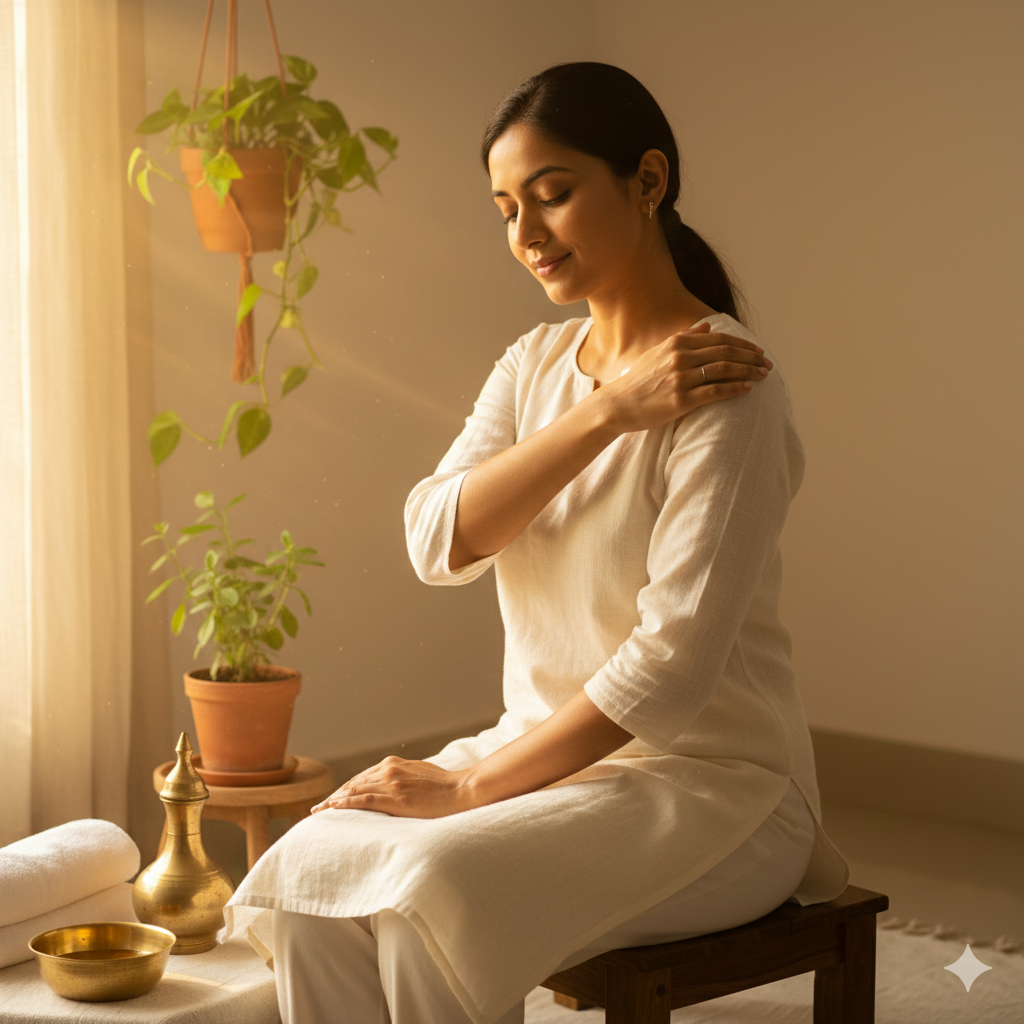
The Principle of Snehana: This is Essential to Understand
Two Types of Snehana (Oleation)
In Ayurveda, Snehana (oleation therapy) is of two types:
1. Bahya Snehana (External Oleation)
- Taila Mardana (oil massage)
- Creams and lotions
- Abhyanga (Ayurvedic therapeutic oil massage)
- Lepa (herbal paste applications)
2. Abhyantara Snehana (Internal Oleation)
- Consuming Ghrita (ghee) in diet
- Internal use of medicated oils
- Snigdha Ahara (unctuous/oily foods)
The Core Principle
“Bahya Snehana is fully effective only when Abhyantara Snehana is adequate.”
This is why people who:
- Give up ghee and oil in the name of dieting
- Eat only salads and dry food
- Stay obsessed with “fat-free” products
…find their skin remains dry no matter how much cream they apply.
The Classical Reference
“Snigdham Mridu Sthiram Chaiva Twacham Kuryat…”
— Classical Ayurvedic Text
Meaning: Proper Snehana (oleation) makes the skin Snigdha (unctuous), Mridu (soft), and Sthira (stable).
But this happens only when oleation is done both internally and externally.
Body Signals: Recognize These Signs
Beyond Skin — Signs of Rukshata (Dryness) Throughout the Body
If you also have these symptoms, understand that the problem runs deep:
Skin-Related Signs:
- Tightness few hours after applying cream
- Immediate dryness after bathing
- Dryness persisting regardless of weather change
- Kandu (itching) on skin
- Skin cracking (especially in winters)
- Rough, scaly patches
- Dull, lifeless complexion
In Other Organs:
- Oshtha Shosha (dry and cracked lips)
- Kesha Rukshata (dry and lifeless hair)
- Parni Patan (cracked heels)
- Nakha Bhangura (brittle nails)
- Netra Rukshata (dry eyes)
- Karna Rukshata (dry ears with flaking)
Digestion-Related:
- Vibandha (constipation tendency)
- Mala Rukshata (dry stool)
- Adhmana (bloating and gas)
- Irregular appetite
General Signs:
- Sandhi Sphutana (cracking sound in joints)
- Shrama (fatigue)
- Nidra Vighna (disturbed sleep)
- Anxiety and restlessness
Understanding According to Your Constitution
Vata Prakriti (Vata Constitution)
Identification:
- Naturally thin, dry skin
- Quickly affected by cold weather
- Fine lines appear early
- Rough texture, especially on elbows and knees
Suitable Oils:
- Tila Taila (sesame oil) — Best choice
- Bala Taila
- Ashwagandha Taila
- Mahanarayan Taila
Special Care:
- Needs more oleation than other types
- Warm oil massage highly beneficial
- Regular Abhyanga essential
- Must avoid cold, dry, light foods
Pitta Prakriti (Pitta Constitution)
Identification:
- Sensitive skin
- Quickly affected by heat
- Tendency towards redness and inflammation
- Prone to sunburn
Suitable Oils:
- Narikela Taila (coconut oil)
- Ghrita (ghee)
- Chandanadi Taila (sandalwood oil)
- Kumkumadi Taila
Special Care:
- Cool oleation preferred
- Avoid very hot oil
- Night-time oil application best
- Aloe vera beneficial
Kapha Prakriti (Kapha Constitution)
Identification:
- Naturally thick, oily skin
- Dry skin less common
- If present, indicates deeper causes
- Prone to congestion in skin
Suitable Oils:
- Sarshapa Taila (mustard oil)
- Light oils in small quantities
- Warming, stimulating oils
Special Care:
- Excess oil can be harmful
- Ushna (warm) oils preferred
- Ruksha Udvartana (dry powder massage) also beneficial
- Focus on stimulating circulation
Kutch’s Climate and Skin: A Local Perspective
For those living in Bhuj, Kutch and surrounding areas, some special considerations apply:
Characteristics of Kutch’s Climate:
- Shushka Vatavaran (dry environment): Low humidity in air
- Grishma Ushna (hot summers): Rapid evaporation of moisture from skin
- Dhuli Yukta Vayu (dusty winds): Additional burden on skin
- Jala Gunvatta (water quality): Hard water in some areas affecting skin
Special Recommendations for Kutch Residents:
1. Jala Prabandhan (Water Management):
- Drink adequate water, but not all at once
- Koshna Jala (lukewarm water) is best
- Narikela Jala (coconut water) beneficial
- Avoid ice-cold water
2. Taila Chayan (Oil Selection):
- Tila Taila best suited for this climate
- Narikela Taila in summers
- Sarshapa Taila in winters (for Kapha types)
- Locally sourced, cold-pressed oils preferred
3. Ahara (Diet):
- Use of local Desi Ghee
- Mausami Phala aur Sabjiyan (seasonal fruits and vegetables)
- Bajra Roti with ghee — traditional and effective
- Chhas (buttermilk) in summers
4. Lifestyle Adjustments:
- Early morning Surya Seva (sun exposure) before heat peaks
- Avoid outdoor activities during peak afternoon
- Keep skin covered but breathable during dusty winds
- Use natural cotton clothing
Ayurvedic Chikitsa (Treatment): Dr. Jigar Gor’s Approach
At Shree Madhav Smaranam Ayurveda Clinic, Bhuj, we treat dry skin with a holistic approach:
Pillars of Treatment:
1. Nidana Parivarjana (Removing the Cause)
- Detailed analysis of Ahara-Vihara (diet and lifestyle)
- Identification of wrong habits
- Lifestyle modification guidance
- Personalized dietary recommendations
2. Shodhana Chikitsa (Purification Therapy)
- Panchakarma (if required):
- Snehapana (internal oleation therapy)
- Virechana (therapeutic purgation)
- Basti Chikitsa (medicated enema therapy) — Most important for Vata disorders
3. Shamana Chikitsa (Palliative Treatment)
- Vata Shamaka Aushadhiya (Vata-pacifying medicines)
- Snehapana (internal oleation with medicated ghee/oil)
- Rasa-Rakta Vardhaka Aushadhiya (medicines to nourish Rasa and Rakta Dhatu)
- Specific formulations based on individual Prakriti
4. Bahya Chikitsa (External Treatment)
- Abhyanga (therapeutic oil massage with specific medicated oils)
- Udvartana (herbal powder massage)
- Lepa (herbal paste applications)
- Parisheka (pouring of medicated liquids)
5. Rasayana Chikitsa (Rejuvenation Therapy)
- For complete regeneration of skin
- Long-term benefits
- Enhances Ojas (vital essence)
- Promotes overall health and longevity
Home Remedies: Simple Supportive Measures
Internal Remedies:
Pratahkala (Morning):
- Koshna Jala (lukewarm water) on empty stomach
- 1 teaspoon Ghrita (ghee) — empty stomach or with meals
- Soaked almonds (4-5 pieces) — Vata pacifying
Bhojana (During Meals):
- Shuddha Desi Ghrita (pure cow’s ghee) — 1-2 teaspoons daily
- Mausami Phala aur Sabjiyan (seasonal fruits and vegetables)
- Include Madhura Rasa (sweet taste) in diet
- Warm, cooked, fresh foods
Ratri (Night):
- Garam Dugdha + Ghrita + Mishri (warm milk with ghee and rock sugar)
- Light dinner 2-3 hours before sleep
- Gulkand (rose petal preserve) — cooling and nourishing
External Remedies:
Abhyanga (Oil Massage):
- Timing: 15-20 minutes before Snana (bathing)
- Oil: Koshna Tila Taila (lukewarm sesame oil)
- Method: Gentle massage on entire body
- Focus Areas: Pada (feet), Kurpara (elbows), Janu (knees), scalp
- Direction: Long strokes on limbs, circular on joints
Snana (Bathing):
- Koshna Jala (lukewarm water) — not very hot
- Minimal use of Sabuna (soap)
- Prakritik Ubatana (natural herbal scrub) preferred
- Short duration — 10-15 minutes maximum
Snana Pashchat (After Bathing):
- Apply light oil immediately while skin is slightly damp
- Do not rub skin vigorously dry
- Pat gently with soft towel
Ratri (Night-time):
- Pada Tala mein Taila (oil on soles of feet)
- Desi Ghrita on Oshtha (lips)
- Light oil on hands and exposed areas
Dinacharya Sudhar (Daily Routine Improvement)
| Time | Activity | Benefit |
|---|---|---|
| Brahma Muhurta (before sunrise) | Wake up | Aligns with natural rhythm |
| Pratahkala (morning) | 15-20 minutes Dhupa Sevana (sun exposure) | Vitamin D, natural warmth |
| Throughout day | Adequate Jala Sevana (water intake) — as per thirst, sip by sip | Hydration |
| Sandhya Kala (evening) | Light Vyayama (exercise) or walking | Improves circulation |
| Ratri (night) | Shayana before 10 PM | Allows body repair |
Vishesh Gharelu Nuskhe (Special Home Recipes)
1. Ghrita-Dugdha (Ghee-Milk Remedy):
Ingredients: 1 glass Garam Dugdha (warm milk) + 1 tsp Ghrita (ghee)
Time: Before sleep
Benefit: Abhyantara Snehana, improves Nidra (sleep)
2. Tila Taila Abhyanga (Sesame Oil Massage):
Oil: Shuddha Tila Taila (pure sesame oil) — slightly warmed
Time: 15-20 minutes before Snana (bathing)
Method: Head to toe gentle massage
Frequency: Daily or at least 3 times per week
3. For Cracked Heels:
Ingredients: Desi Ghrita + Haridra (turmeric) — make paste
Method: Apply at night, wear cotton socks
Duration: Continue for 2-3 weeks
4. For Lips:
Ingredient: Shuddha Desi Ghrita(Ghee)
Method: Apply 2-3 times during day and before sleep
Alternative: Honey + Ghee mixture
5. For Hair:
Oil: Keshya Hair Care Oil ( Prepared by Dr.Jigar Gor )
Method: Warm oil scalp massage
Timing: 1 hour before washing or overnight
Frequency: 2-3 times per weekAlternative: Pre Shampoo Hair Oil ( By Dr.Jigar Gor )
6. Vata-Shamaka Kashaya (Vata-Pacifying Drink):
Ingredients: Ajwain (carom seeds) + Saunf (fennel) + Jeera (cumin)
Method: Boil 1 tsp mixture in 2 cups water, reduce to 1 cup
Timing: Warm, after meals
Benefit: Improves Agni, pacifies Vata
Pathya-Apathya (Dos and Don’ts)
Pathya — What to Follow
Ahara (Diet):
✅ Snigdha Ahara (unctuous, oily foods)
✅ Ushna Ahara (warm, freshly cooked foods)
✅ Madhura Rasa Pradhana (sweet taste predominant)
✅ Ghrita (ghee) in daily diet
✅ Tila (sesame) in various forms
✅ Dugdha (milk) if suitable
✅ Mausami Phala (seasonal fruits)
✅ Warm soups and stews
✅ Adequate healthy fats
Vihara (Lifestyle):
✅ Niyamita Dinacharya (regular daily routine)
✅ Purna Nidra (adequate sleep) — 7-8 hours
✅ Niyamita Abhyanga (regular oil massage)
✅ Madhyama Vyayama (moderate exercise)
✅ Pratahkala Dhupa (morning sunlight)
✅ Stress management practices
✅ Pranayama (breathing exercises)
Apathya — What to Avoid
Ahara (Diet):
❌ Ati Ruksha Ahara (very dry food)
❌ Vasi Bhojana (stale food)
❌ Adhika Katu-Tikta (excess pungent-bitter)
❌ Shita Jala/Shita Paneya (cold water/cold drinks)
❌ Fast food and processed food
❌ Excess caffeine
❌ Excess raw salads
❌ Skipping meals
❌ Eating while distracted
Vihara (Lifestyle):
❌ Ratri Jagaran (staying up late)
❌ Ati Ushna Jala Snana (very hot water bathing)
❌ Excess time in AC
❌ Complete Dhupa Pariharjana (complete sun avoidance)
❌ Irregular sleep patterns
❌ Excessive travel
❌ Suppressing natural urges
Twak Dekhbhal (Skin Care):
❌ Frequent use of Sabuna (soap)
❌ Chemical-laden products
❌ Vigorous rubbing of skin
❌ Changing cream every week
❌ Using very hot water on face
❌ Over-exfoliation
When to Consult a Doctor?:
Seek Immediate Consultation If:
- No improvement after 2-3 weeks of home remedies
- Vidarana (cracks) or Raktasrava (bleeding) on skin
- Very intense Kandu (itching)
- Skin symptoms accompanied by other signs (Jwara/fever, Shrama/fatigue)
- Kesha Patana (hair fall) along with dry skin
- Vajan Parivartana (weight changes)
- Problem started after taking some Aushadhi (medication)
- Persistent patches or discoloration
- Signs of infection (pus, increasing redness)
Vishesh Paristhitiyan (Special Circumstances):
- Garbhavastha (Pregnancy): Special care needed
- Purani Bimari (Chronic illness): Diabetes, thyroid, etc.
- Aushadhi Sevan (Taking medications): Drug interactions possible
- Bachchon mein (In children): Different approach needed
- Vriddhavastha (Elderly): Age-related considerations
The Connection Between Dry Skin and Other Vata Disorders
Understanding the Bigger Picture
Dry skin rarely exists in isolation. It’s often part of a larger pattern of Vata Vriddhi (Vata aggravation). Common associated conditions include:
Sandhi Vikara (Joint Problems):
- Sandhi Shoola (joint pain)
- Sandhi Graha (stiffness)
- Osteoarthritis
Mala Vibandha (Constipation):
- Irregular bowel movements
- Hard, dry stools
- Bloating
Manasika Vikara (Mental Conditions):
- Chinta (anxiety)
- Anidra (insomnia)
- Restlessness
Keshgata Vikara (Hair Problems):
- Kesha Rukshata (dry hair)
- Kesha Patana (hair fall)
- Dandruff
If you have multiple symptoms from this list along with dry skin, it strongly indicates a Vata imbalance at the systemic level, requiring comprehensive treatment rather than just topical solutions.
Understanding Ojas and Skin Health
What is Ojas?
In Ayurveda, Ojas is the ultimate essence of all Dhatus (tissues). It represents:
- Vital energy
- Immunity
- Lustre and glow
- Overall vitality
Connection with Skin
When Ojas is adequate:
- Skin has natural Prabha (glow)
- Adequate Snigdhata (moisture)
- Good healing capacity
- Resistance to infections
When Ojas is depleted:
- Skin becomes dull and lifeless
- Persistent dryness despite care
- Slow healing
- Prone to problems
Ways to Enhance Ojas
- Adequate rest and Nidra (sleep)
- Sattvika Ahara (pure, wholesome food)
- Positive mental states
- Specific Rasayana (rejuvenative) therapies
- Avoiding Ojakshaya Karaka (Ojas-depleting factors) like excess stress, overwork, irregular habits
Frequently Asked Questions (FAQs)
Q1: Why does skin remain dry even after applying cream?
Answer: According to Ayurveda, when Abhyantara Snehana (internal oleation — ghee/oil in diet) is insufficient and Agni (digestion) is weak, externally applied cream cannot be properly absorbed by the skin. The solution requires both internal and external oleation. The skin’s Bhrajak Pitta must be functioning well to “digest” and absorb what you apply externally.
Q2: Which oil is best for dry skin?
Answer: For Vata Prakriti and most dry skin conditions, Tila Taila (sesame oil) is best due to its Ushna (warming), Guru (heavy), and Snigdha (unctuous) qualities that directly counteract Vata. For Pitta Prakriti, Narikela Taila (coconut oil) is better due to its cooling properties. To know your Prakriti, consult an Ayurveda expert.
Q3: Does eating ghee improve skin?
Answer: Yes, Shuddha Desi Ghrita (pure cow’s ghee) is the best source of Abhyantara Snehana. It nourishes Rasa Dhatu which ultimately provides moisture to the skin. Consuming 1-2 teaspoons of ghee daily is beneficial. Ghee also enhances Agni (digestion) and improves the absorption of nutrients. However, quantity should be adjusted based on your Prakriti and digestive capacity.
Q4: How to do Abhyanga for dry skin?
Answer: Perform Abhyanga with Koshna Tila Taila (lukewarm sesame oil) 15-20 minutes before Snana (bathing). Massage the entire body gently using:
- Long strokes on arms and legs
- Circular motions on joints
- Gentle circular movements on abdomen
Pay special attention to Pada (feet), Kurpara (elbows), and Janu (knees). Then bathe with lukewarm water. Ideally, do this daily or at least 3-4 times per week.
Q5: What special precautions should Bhuj/Kutch residents take for dry skin?
Answer: In Kutch’s dry climate, extra care is necessary:
- Drink adequate water throughout the day
- Perform regular Abhyanga
- Include Ghrita and Taila in diet
- Don’t spend excessive time in AC
- Use local Desi Ghee
- Protect skin from dusty winds
- Morning sun exposure is beneficial
For local consultation, contact MS Ayurved, Bhuj.
Q6: Is there a connection between dry skin and hair fall?
Answer: Yes, both problems are often linked to the same cause — Vata Vriddhi and Rasa Dhatu Kshaya. When both problems exist together, it indicates a deeper imbalance, and specialist consultation is necessary. Treatment approach would address the root cause benefiting both skin and hair.
Q7: When is Panchakarma necessary for dry skin?
Answer: Panchakarma is recommended when:
- Regular remedies don’t help
- The problem is chronic (lasting months or years)
- Other Vata Vikara (Vata disorders) are also present
- There’s significant Ama (toxin) accumulation
Basti Chikitsa (medicated enema) is especially beneficial as it directly addresses Vata Dosha, which is seated in the colon. Snehapana (internal oleation) before Panchakarma helps deeply nourish all tissues. Guidance from a qualified Ayurveda Chikitsak is essential.
Q8: Can dry skin be related to thyroid problems?
Answer: Yes, from a modern perspective, hypothyroidism often causes dry skin. From an Ayurvedic view, thyroid imbalance involves Agni Mandya (weak metabolic fire) which affects Dhatu Poshana (tissue nourishment). Treatment would address the underlying Agni and Dosha imbalance. If you suspect thyroid issues, get tested and seek appropriate treatment.
Q9: How long does it take to see results with Ayurvedic treatment?
Answer: This depends on:
- Duration of the problem
- Depth of the imbalance
- Adherence to treatment
- Individual Prakriti
Generally:
- Mild cases: 2-4 weeks
- Moderate cases: 1-3 months
- Chronic cases: 3-6 months or longer
Ayurveda works on the root cause, so while it may take longer, results are usually more sustainable.
Q10: Is dry skin hereditary?
Answer: Prakriti (constitutional type) is determined at conception and is influenced by parents. If you have Vata Prakriti, you’re naturally more prone to dryness. However, Prakriti is not disease — it’s tendency. With proper Ahara-Vihara (diet-lifestyle), even Vata Prakriti individuals can maintain healthy, well-moisturized skin. What you do matters more than what you inherit.
Dr. Jigar Gor’s Message
“In Ayurveda, beautiful skin is not created from outside — it is supported from within.”
Working as an Ayurvedic physician in Bhuj, Kutch for more than 18 years, I have observed that the root of most skin problems lies inside the body.
Until we:
- Eat the right Ahara (diet)
- Improve our Vihara (lifestyle)
- Calm our Mana (mind)
…external treatments remain incomplete.
“The skin is a window to your internal health. When you see persistent dryness despite external care, your body is asking you to look within.”
The path of Ayurveda is slower but sustainable. It addresses not just Lakshana (symptoms) but Karana (root cause). When the foundation is strong, external care works beautifully.
I encourage everyone to understand that:
- Quick fixes rarely work long-term
- Your body is intelligent and gives clear signals
- True skin health is a reflection of overall wellbeing
- Prevention through lifestyle is better than cure
Saransha (Summary)
Key Points:
- Ruksha Twak (dry skin) is not merely an external problem — it is a signal of internal imbalance
- Nourishment comes from three levels:
- Agni (digestive fire)
- Rasa Dhatu (nutrient fluid)
- Bhrajak Pitta (skin’s metabolic fire)
- Two types of Snehana are essential:
- Bahya (external — oil/cream)
- Abhyantara (internal — ghee/oil in diet)
- Vihara (Lifestyle) is crucial:
- Niyamita Dinacharya (regular routine)
- Purna Nidra (adequate sleep)
- Samyak Ahara (proper diet)
- Manasik Shanti (mental peace)
- Local climate considerations:
- Kutch’s dry climate requires special care
- Adapt routines to environment
- Holistic approach works best:
- Address Dosha imbalance
- Improve Agni
- Nourish Dhatus
- Support externally
- Be patient:
- Root cause treatment takes time
- Results are sustainable
- Prevention is key
Take the Next Step
If Ruksha Twak (dry skin):
- Has persisted for a long time
- Isn’t improving with home remedies
- Is accompanied by other symptoms
Then understanding the Karana (root cause) deeply is essential.
Ek sahi parimarsh apko sahi disha de sakta hai.
(A proper consultation can give you the right direction.)
Sampark Karen (Contact)
Dr. Jigar Gor
Ayurveda Expert | MS Ayurved
📍 Location: Narayan Complex, Nr.Lohana Samajwadi, Nvavas, MADHAPAR, Bhuj, Kutch, Gujarat, India
📞 Phone: 9724157515
🌐 Website: www.msayurved.com
Consultation Available:
- In-clinic consultation (Bhuj)
- Online consultation (Video/Phone)
- Comprehensive Prakriti Analysis
- Personalized Treatment Plans


